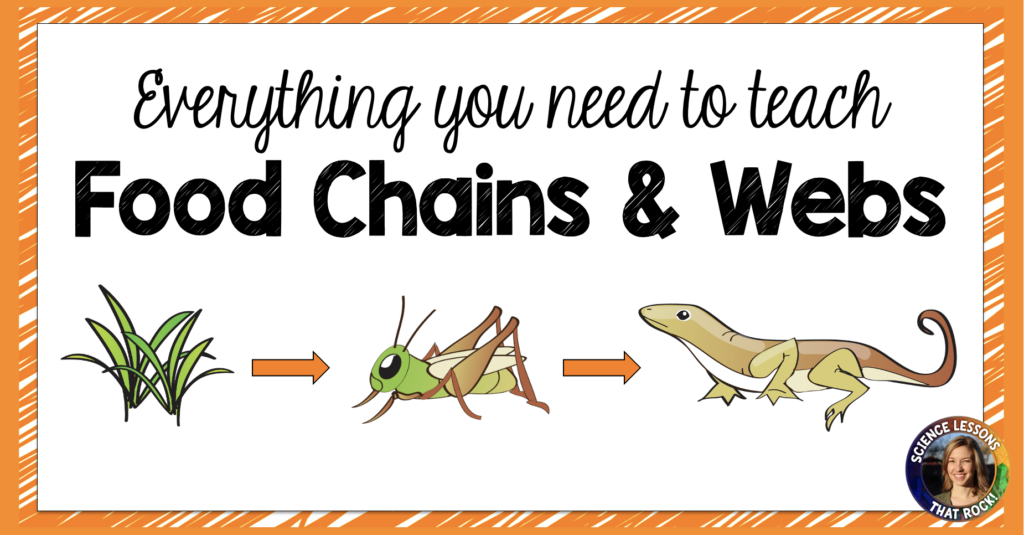
Is food chains up next in your curriculum? Most students learn food chains in the elementary grades, so how do you make it interesting and rigorous at the secondary level? Here are some great options:
Food Chain and Food Web Lesson Plan Ideas
1. In this interactive from the BBC, students go through 3 levels and identify food chains within a Savannah ecosystem.
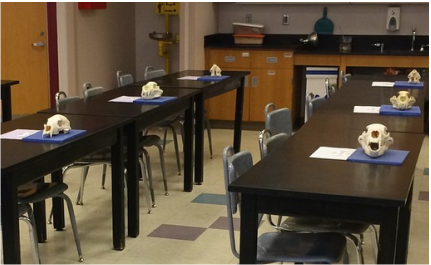
2. This skull lab is always a hit! I take out the skulls before introducing vocabulary words like herbivore, carnivore, nocturnal, or diurnal. Students will analyze the skulls and make inferences about how the animal lived. They have a really fun time trying to figure out which animals they are too! Don’t have skulls handy? Don’t worry! I have a great paper version of this lab in my teachers pay teachers store. You can find it on my website or on TpT.

3. Take the guessing out of creating food chains and webs! Students will create a food chain and web with 36 given organism cards. (I put students in groups of 3 to share cards and save paper). Each card has an organism, picture, what it eats, and what it gets eaten by. No more “Miss, what does a skunk eat?” You can find this activity on my website or on TpT.
4. Here is a great youtube video on food chains. It shows a food chain in the everglades, and reviews important vocabulary like herbivore, carnivore, producer, and consumer.
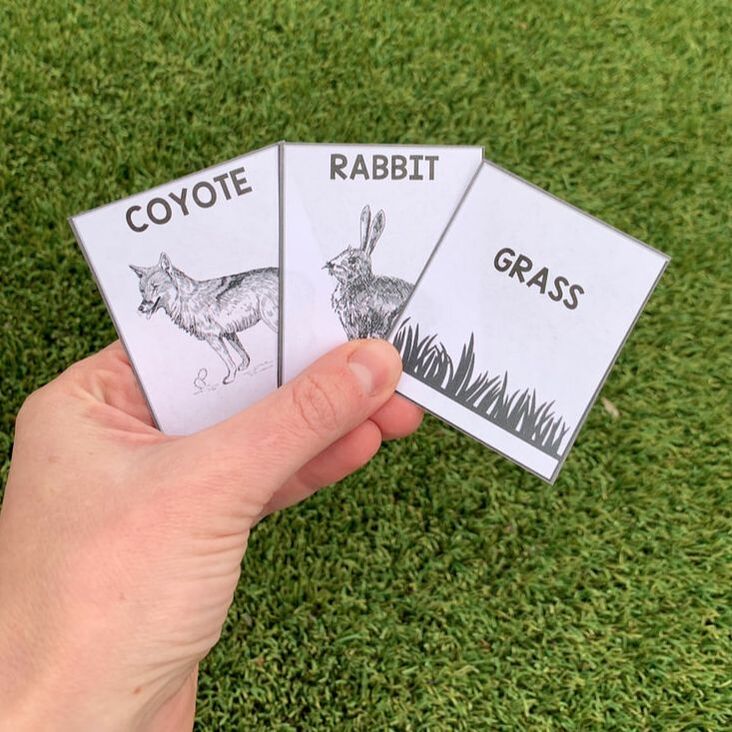
5. This lesson demonstrates why it is important that trophic levels remain in balance. In this activity, students play the role of grass (producer), rabbit (primary consumer), or a coyote (secondary consumer). Throughout the 5 rounds, students will go around the room and pair up with another student. If they find a prey they get to eat it. If they find another organism of the same species, they reproduce. If they don’t eat or get eaten that round, they are out. Students will quickly learn that there needs to be few secondary consumers and a lot of producers for a community to be sustainable. You can find it on my website or on TpT.

6. The Natural History Museum of Utah has an investigation titled “How is energy transfer and matter cycling affected in a changing ecosystem?” Students will work through an interactive where they will identify producers and consumers in the ecosystem and determine what will happen to the ecosystem if the Lodgepole pines die off.
You need to sign up for a free teacher account first, but I promise you it’s worth it! It is self-grading and you will be able to see all your students answers.

7. Producers and consumers get all the love… what about decomposers? Don’t skip over this vital part of the food web.
One way to show decomposers some love is by growing some classroom oyster mushrooms. You can find them on Amazon (affiliate link). They are fast growing and edible so you can take them home for dinner!
Be sure to check out this blog post with a ton of other decomposer lesson ideas!
8. Have your students dissect owl pellets! They might have done this in elementary school, but you can up the rigor with having students make trophic pyramids, calculate energy transfer, and reassemble the skeleton. Head to this blog post with more details.
When you make ecology hands on and interactive, students will have a blast. Have fun!
Rock on,