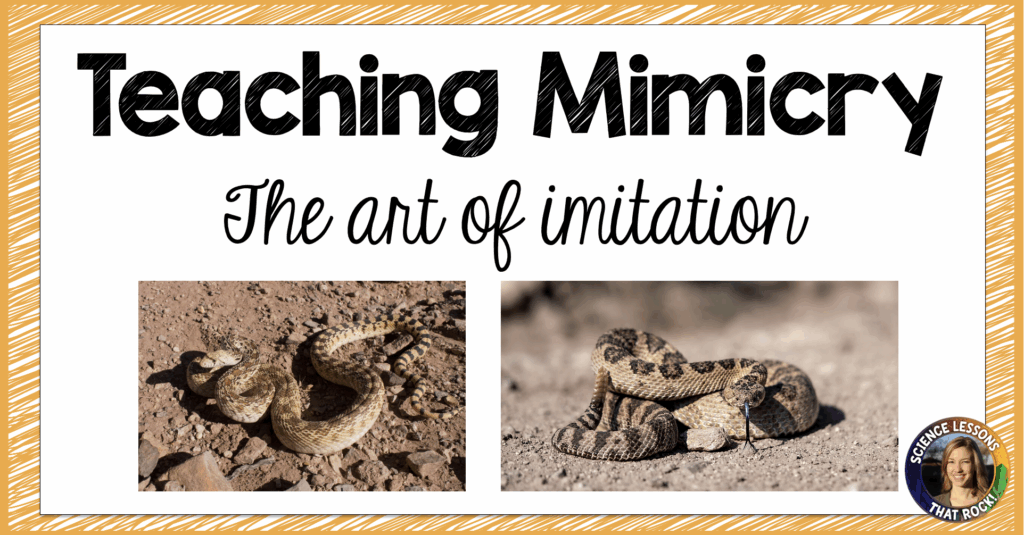
I live in Phoenix and recently had a gopher snake hanging out near my front door. You would laugh if you saw my reaction walking up on the doorbell camera! At first glance, gopher snakes look awfully similar to rattle snakes. Once I realized he was missing a rattle I calmed down and let him enjoy my sunny porch.
I brought this example up with my students when teaching mimicry and adaptations. Why is it beneficial for the gopher snake to look like a rattlesnake? Did the similarities happen by chance? Using native examples that your students are familiar with leads to healthy discussion.
If you’re looking for a new activity to add to your mimicry and adaptations unit, you should definitely check out this free Velvet Ants Interactive from Research Quest. It was developed by the Natural History Museum of Utah, and is a fantastic classroom resource for middle and high school students.
Mimicry Lesson: Velvet Ants Investigation
This three part, inquiry based activity is a ready-to-use investigation where students explore how mimicry works, and why it matters for survival. Its engaging, standards-aligned, and 100% free. Here’s how it works:

PART 1: The interactive begins by having students play the role of a Western Fence lizard, a predator choosing which bugs are safe to eat. Is it the furry ones? The colorful ones? If students guess incorrectly too many times the lizard dies! Over time students will start noticing patterns and learn which bugs lead to survival and which will cause a stomachache. Throughout this section students are learning how appearance influences survival.

PART 2: Students explore real digitized museum specimens of velvet ants and their mimics. They measure and compare physical traits like size, color, and pattern. With help from a museum entomologist, students collect and analyze data, looking for evidence that explains how mimicry works.

PART 3: Students apply what they’ve learned to make predictions about the future: If the environment changes, will the mimics still thrive? Could predators eventually catch on? This final stage challenges students to think critically about how adaptations evolve over time.
Why Teachers Love It
The Velvet Ants Interactive is designed with classrooms in mind. You’ll love that it’s…
- Completely free: It’s hosted by the Natural History Museum of Utah and available online at no cost.
- Student-led and inquiry-based: The webquest is structured like a real scientific investigation. Students make choices, gather data, and formulate explanations using evidence.
- Flexible format: The activity can span one or multiple class periods depending on your schedule.
- Aligned with NGSS: It directly supports MS-LS2-2 (Construct an explanation that predicts patterns of interactions among organisms across multiple ecosystems).
- Visually engaging: The high-quality specimen images and interactive design keep students engaged.
While the site says it’s aimed at middle grades, this could definitely be included in the high school biology classroom. I would add this interactive to my natural selection unit and explore how mimicry can drive evolutionary change.
Ready to check it out? Explore the free Velvet Ants Interactive HERE!
Rock on,